
Winter 2025—2026
Throughout the fall semester, Rice’s Government Relations team focused on the building blocks for long-term state and federal policy success. While the pace of federal issues and our engagement in protection of the university’s interests both remained high, it was at the state level where we saw years of consistent, collaborative work lead to major funding developments after the passage of key statewide ballot propositions in last November’s general election.
Texas Propositions Pass
Brain health and water become major state-funded priorities
Victories for Water and Brain Health Research
With the November 2025 election, Texas voters approved Proposition 14, the constitutional amendment providing $3 billion to establish the Dementia Prevention and Research Institute of Texas (DPRIT), and Proposition 4, allocating up to $1 billion into the Texas Water Fund to fix infrastructure, develop new sources and support conservation efforts to help meet the state’s water demands. Rice is strategically positioned to capitalize on the passage of both propositions.

Strategic Partnerships for Proposition 4
This funding is directed primarily to political subdivisions (cities, utilities, river authorities, etc.) but Rice University’s WaTER Institute can benefit by partnering with eligible entities, positioning itself as a research and technical leader in sustainable water planning and treatment.
Leading the Charge in Brain Health
Eligible for Proposition 14 funding, Rice has major brain health-focused initiatives, including the Rice Brain Institute (RBI). DPRIT funds can support RBI efforts across engineering, natural sciences, human performance and computational neuroscience.

Building Momentum Through Advocacy
Public Affairs coordinated communications to raise awareness of Proposition 14 and DPRIT’s importance, including social media activities, partnerships with the Alzheimer’s Association, the Texas Medical Center and a series of brain-health stories published before election day.
Funding for Flood Intelligence
Rice University’s SSPEED Center collaborates with UT-Arlington on flood modeling
During 2025's second special session, the Texas Legislature allocated $28 million to improve weather forecasting as part of disaster relief and prevention funds in response to the deadly July 4 flash floods in Central Texas.
Government Relations helped ensure $4 million of that was allocated to Rice’s Severe Storm Prediction, Education and Evacuation from Disasters (SSPEED) Center through a partnership between Rice University and the University of Texas at Arlington.
The SSPEED Center specializes in translating environmental data into actionable flood risk intelligence. Leveraging advanced modeling and decision-support tools, the SSPEED Center will use these funds to develop and provide location-specific flood forecasts to guide evacuation planning, infrastructure management and emergency response.
Protecting Innovation
Higher Education Research Security Council meeting in Austin
House Bill 127 established the Texas Higher Education Research Security Council (HERSC) to ensure that Texas higher education institutions remain national leaders in research excellence while safeguarding our intellectual property, proprietary data and innovation ecosystem.
Government Relations helped ensure Rice has a seat at the table with Tam Dao, associate vice president of Campus Safety and Research Security, named a member of the council that includes representatives from major public university systems, private research institutions, and medical schools from across Texas.
On Dec. 3, the HERSC met for the first time in Austin to start the process to establish statewide standards and best practices for research security, data protection and compliance.
Federal Agency Funding Update
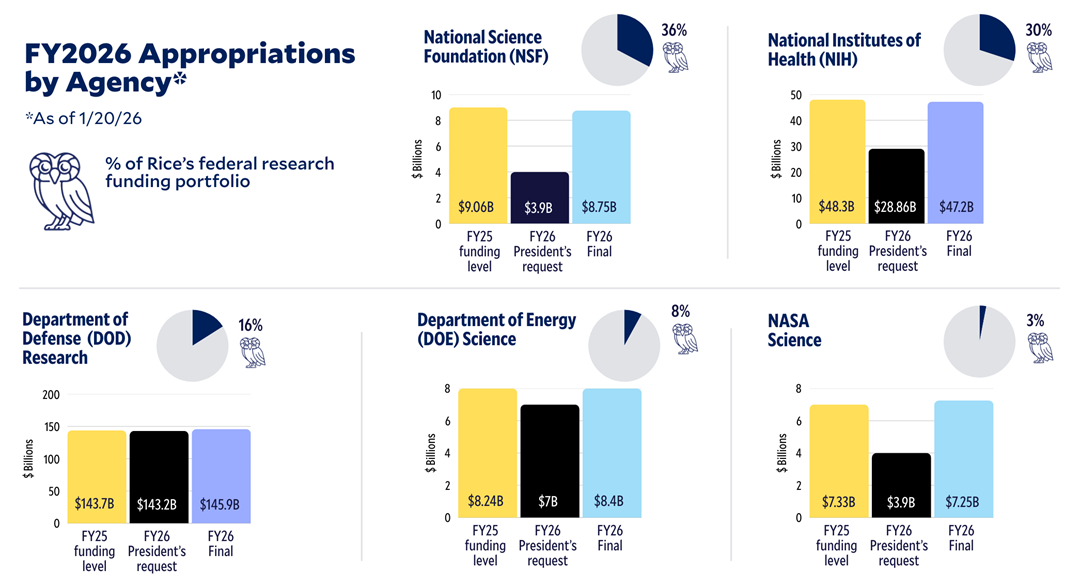
After the longest federal government shutdown in history, Congress is working to complete the Fiscal Year 2026 appropriations process before a Jan. 30 deadline. The university research community’s continued efforts to oppose science and research funding cuts is having an impact.
‘Compact for Academic Excellence in Higher Education’ Explained’
Issued by the Trump Administration in October, it offered an initial group of nine universities unspecified preferential treatment for compliance with its terms, while threatening their nonprofit tax status and the loss of federal research grants and student loan access for noncompliance.
Additional institutions invited several weeks later met with the White House and provided feedback, but none signed the agreement.
Since then it has largely been rejected by our sector as dozens of higher education associations issued statements opposing or questioning its terms.
On Nov. 19, Department of Education leaders hosted a roundtable with university leaders, think tanks and education advocates on "the need for bold reforms to restore public confidence in higher education." Feedback was given but no breakthroughs emerged.
A few small institutions have expressed interest in the compact, with New College of Florida being the first to formally accept terms.
Other Developments
Rice GR is tracking and engaging across a variety of additional issues, including:
Duration of status and optional practical training changes
Name, image and likeness (NIL) in college athletics
Intellectual property legislation and a potential “innovation dividend” executive order
Department of Education reorganization
State legislative Select Committee on Civil Discourse and Freedom of Speech in Higher Education
Advocacy in Action
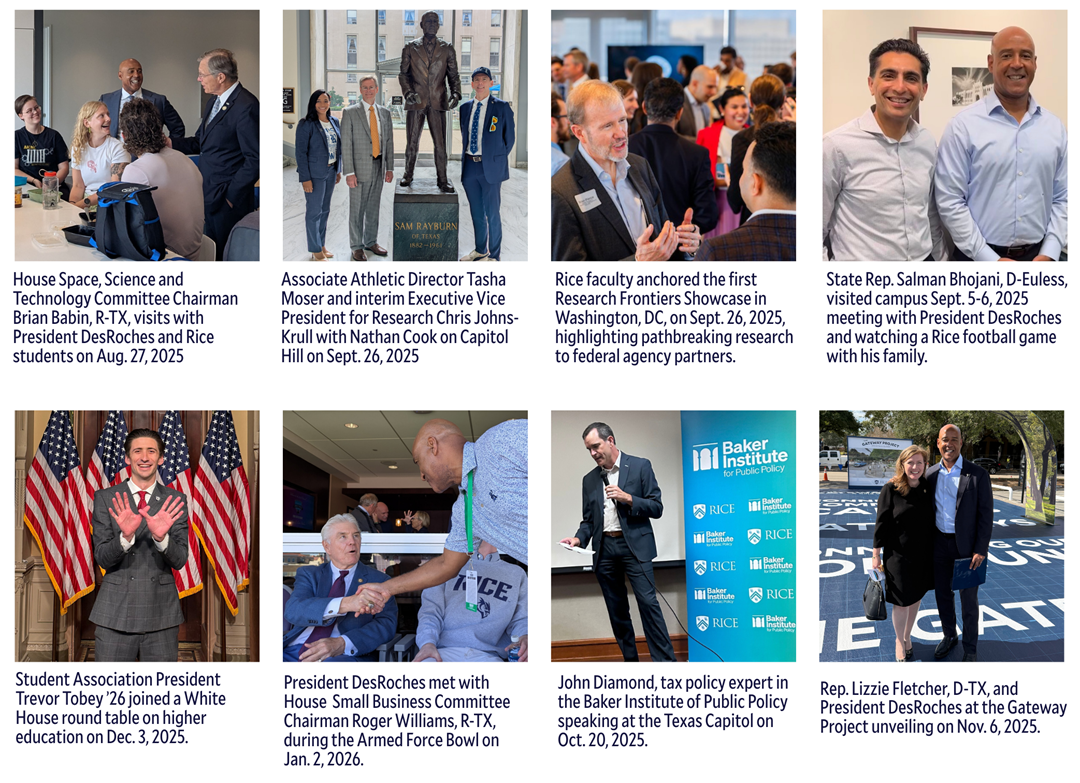
Continued Advocacy is Essential
TAKE ACTION
Join the Research for a Stronger America campaign at governmentrelations.rice.edu/stronger-america
STAY INFORMED
For more information and updates, visit us at publicaffairs.rice.edu/government-relations.