
Fall 2026
Throughout the spring and summer, Rice’s Government Relations team nurtured the university’s ambitions amid continued federal volatility and hard-won state victories that promise to turn our foundational work into expanding relevance in Austin and Washington.
Change Remains Constant in D.C.
FY2026 appropriations are finalized, but only after two shutdowns.
$47.2B to NIH
NIH: plus $458M over FY25, plus $1.5B for ARPA-H
$9.0B to NSF
NSF: 3.4% below FY25
$145.9B to DOD
DOD Research: plus 3.4% over FY25
Both the Defense and Labor-HHS-Education bills block NIH, HHS and DOD from arbitrarily capping negotiated indirect cost rates and direct agencies to further consider the FAIR model.
The Slow Spend: Appropriations ≠ Funding
Congress largely protected research funding in the FY26 spending bills. But federal agencies are unusually slow to expend their resources, subjecting grants to political review and stalling merit-based awards, the same dynamic driving the OMB Uniform Guidance rule fight that is detailed below. Congress has heard from Rice on this issue.
National Science Foundation’s FY26 spending slows
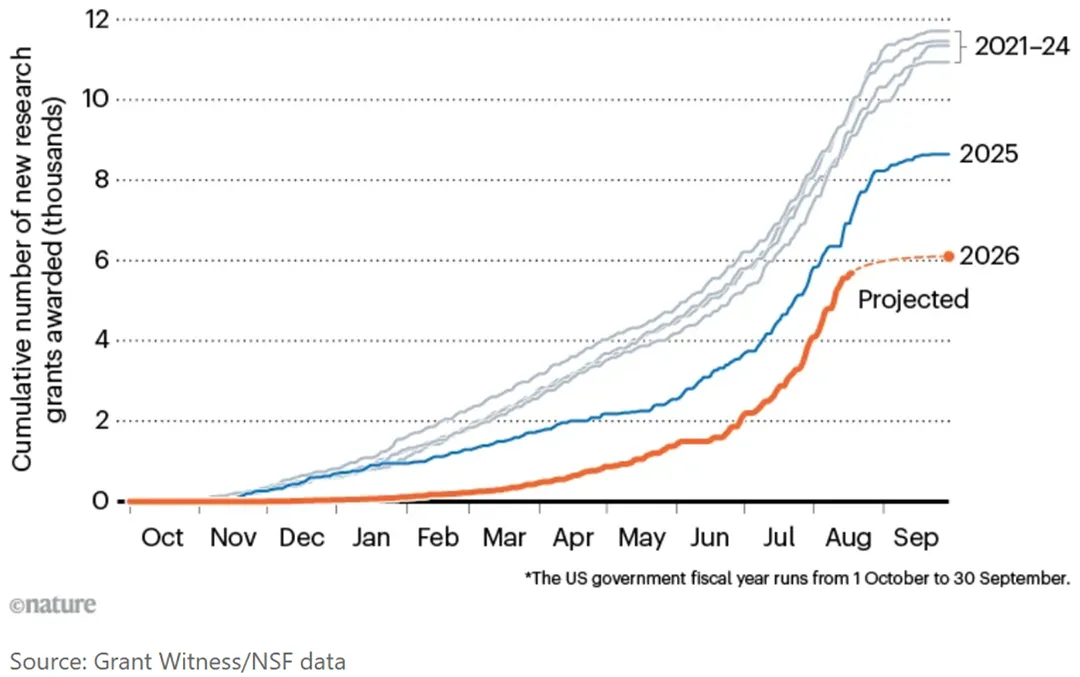
Nature: Internal agency data shows that the NSF will issue about 6,100 new awards this fiscal year, which is 29% fewer than in 2025 and 46% fewer than the annual average for 2021–2024.
Rice weighs in: OMB's proposed federal grantmaking overhaul has high stakes for every federal grant recipient
The Office of Management and Budget (OMB) proposed rule changes allowing political appointees to dictate federal grant decisions and terminate existing awards without due process, threatening federal funding and the university-government research partnership.
In addition to organizing and submitting Rice’s public comments expressing concerns about the proposed rule, Rice’s Government Relations team leveraged state and regional partners to contact our congressional delegation, supporting Senate passage of a funding bill blocking the OMB from implementing its rule before Dec. 11. The House must now act by Sept. 30.
We expect to continue engagement on this OMB rule well into 2027.
Turning Propositions Into Programs
Dementia research ballot win last fall awaits full realization.
Litigation slows brain research fund while other wins bear fruit.
Despite establishment of the Dementia Prevention and Research Institute of Texas (DPRIT) being delayed by litigation, Rice is converting last November's brain research ballot victory into concrete progress. The Rice Brain Institute launched with an internal seed-grant program running ahead of state funding. Meanwhile, Rice landed major state grants for cancer and space research from agencies we helped create, and the Higher Education Research Security Council (HERSC) moved into substantive policy work.
Federal Agency Funding Update
After the longest federal government shutdown in history, Congress is working to complete the Fiscal Year 2026 appropriations process before a Jan. 30 deadline. The university research community’s continued efforts to oppose science and research funding cuts is having an impact.

DPRIT in Legal Limbo
A lawsuit challenging the November 2025 election's voting-machine certification blocks Proposition 14's Dementia Prevention and Research Institute of Texas from taking effect. A judge recently rejected the plaintiffs' standing, but the suit remains unresolved, and the governor won't certify the election until the litigation concludes.
Rice Brain Institute Launches
Despite DPRIT's limbo, the Rice Brain Institute has formally launched. An internal DPRIT Seed Grant Program has already funded 12 pilot projects, positioning Rice to move immediately once state funds become available.
New: CPRIT Grant Fuels Renewal Advocacy
CPRIT recently approved Rice’s $2 million Scholar Recruitment Grant to hire a researcher studying genomic context and the functional impact of cancer’s structural variation. We use the impact of such awards to advocate for CPRIT’s renewal past 2029.
New: Texas Space Commission Grant
The Texas Space Commission (TSC) approved a $14.15 million grant to launch a Center for Space Technologies within the Rice Space Institute, emphasizing community-college and industry partnerships tied to NASA's Artemis program.
Funding for Flood Intelligence

Rice's SSPEED Center partners with UT Arlington on Hill Country flood safety
Rice's SSPEED Center and UT Arlington's Water Engineering Research Center continue to build a real-time flood warning system for the Texas Hill Country, following the Legislature's response to the July 2025 floods that killed more than 130 people. Government Relations was critical to the Texas governor's office awarding $4 million to UT Arlington, with Rice as a subawardee.
Protecting Innovation

HERSC moves from formation to substance
The Higher Education Research Security Council met twice, with a third meeting scheduled, and made significant progress developing a model research security policy for Texas universities.
Tam Dao, Rice’s associate vice president for campus safety and research security, testified to the Texas Senate and House Higher Education Committees on HB 127 implementation and Rice’s risk-based approach to protect both research integrity and the open exchange of ideas.
Advocacy in Action

Continued Advocacy is Essential
TAKE ACTION
Join the Research for a Stronger America campaign at governmentrelations.rice.edu/stronger-america
STAY INFORMED
For more information and updates, visit us at publicaffairs.rice.edu/government-relations.